Beyond the Hype: Why Adaptive Dialogue Systems Enhance L2 Learning

You’ve decided to practice a new language. Imagine you could do it anytime, anywhere, without waiting for a nice friend or a 24/7 tutor. Want to rehearse talking about your job or hobbies for the hundredth time? With no worries, no pressure, and a safe space to make mistakes? This is where spoken dialogue systems come in. But how can a bot really support language learning? Can an automated conversation offer the same benefits as talking to a person? Nothing replaces human connection. But access matters. Bots are always available, infinitely patient, and never tired of hearing the same sentence ten times in a row. They can adapt to each learner’s needs, making practice flexible, low-pressure, and personalized. To see if these benefits translate into real learning, Professor Bibauw and colleagues analyzed 17 experimental studies involving 803 learners, synthesizing years of research on conversational agents. Their recent meta-analysis published in Language Learning & Technology provides the strongest evidence to date on how much dialogue systems actually help people learn a language. So what does the evidence say? Do dialogue systems actually improve L2 proficiency? The short answer: Yes, they work Significant lasting learning Students who practice with a conversational agent showed significant improvement (overall effect size d = 0.59). From a cognitive interactionist viewpoint, this makes sense. These meaningful interactions with a bot create opportunities for input and output, noticing, negotiation, and feedback, all necessary ingredients for language acquisition (Gass & Mackey, 2015). Interestingly, beginner and low-intermediate students (A1-A2) benefit the most. As proficiency increases, effects decrease, suggesting that conversational agents are most powerful when students need repeated, low-anxiety, and structured communicative practice. Just as important, dialogue practice leads to long-term learning. Students not only showed immediate improvements in their L2 proficiency after conversations, but these gains remained significant when tested later. The learning that happens during these dialogues sticks. Another important question was asked: What makes some systems better than others? Design choices matter; not all bots are created equal. The meta-analysis highlights some benefits based on the interactional design: Guided, scripted dialogues led to the strongest gains, followed by goal-oriented dialogues. Why? Because structure encourages clearer communicative goals, predictable input, and better targeted feedback. Free chat may feel more “natural,” but it often lacks the scaffolding students need to actually improve. Instructional design matters just as much, if not more, than the latest technology. Corrective feedback makes a difference. Systems that offer corrective feedback outperformed those without it. Both implicit (recasts) and explicit forms of feedback improved learning, with a slight preference for explicit correction, aligned with decades of second language acquisition research (e.g., Nassaji & Kartchava, 2021). The takeaway is clear: conversational practice alone isn’t enough. Pedagogical feedback matters. Gamification boosts learning. Adding gaming elements showed a significantly stronger impact on L2 development than non-gamified ones, highlighting the importance of motivational design in dialogue systems. Rewards, challenges, and progress indicators increase motivation, sustain effort, and help students stay engaged while practicing the L2. Why does this matter? Dialogue systems are powerful tools for language learning, especially when combining strong instructional design with advanced NLP. This meta-analysis provides empirical support for the kind of adaptive, task-based, and feedback-rich conversational experiences that Linguineo builds. It reinforces several principles that match our philosophy: Dialogue systems are not just technology; they are effective when paired with thoughtful learning design, a principle at the heart of Linguineo. Original article Bibauw, S., Van den Noortgate, W., François, F., & Desmet, P. (2022). Dialogue systems for language learning: A meta-analysis. Language Learning & Technology, 26(1), 1–24. https://doi.org/10.64152/10125/73488 Other work cited Gass, S. M., & Mackey, A. (2015). Input, interaction, and output in second language acquisition. In B. Van Patten & J. Williams (Eds.), Theories in second language acquisition (pp. 194–220). Nassaji, H., & Kartchava, E. (Eds.). (2021). The Cambridge handbook of corrective feedback in second language learning and teaching. Cambridge University Press. Post photo by Shantanu Kumar on Unsplash
New Research Behind Real Adaptivity in Language Games
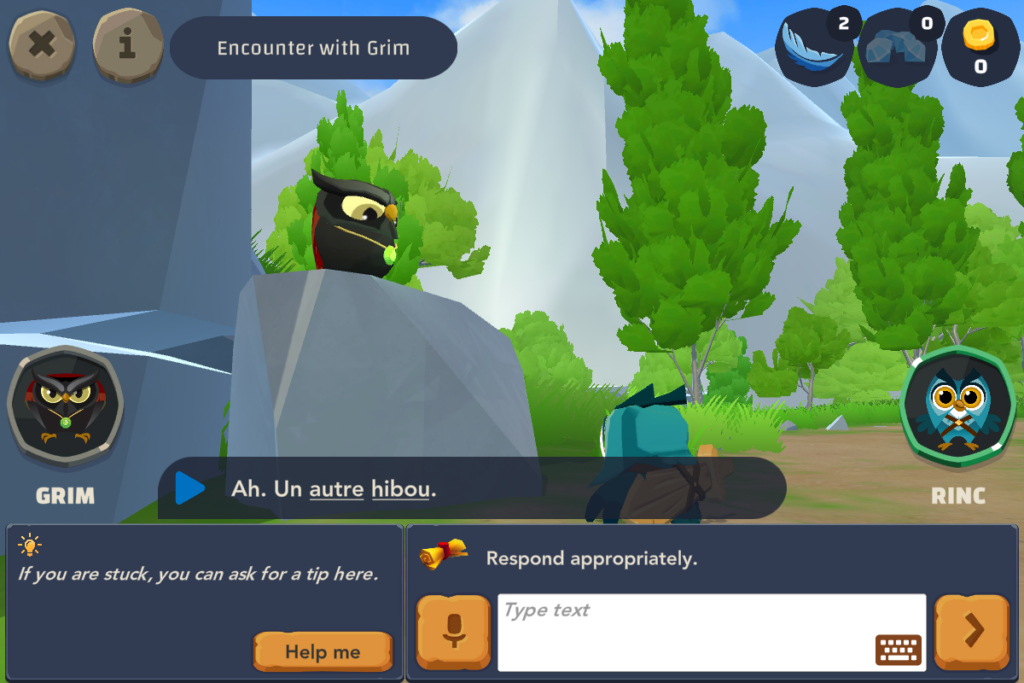
Imagine you’re playing a game while learning a language. You have your cute little owl (don’t worry, ours won’t threaten your streak), gathering intel, talking to characters, making choices, trying to stay fully immersed in this adventure when, without realizing it, the game quietly steps in and gives you a hand. Maybe it whispers the first letters you need. Perhaps it speaks slower? Or gives you an easier quest. Almost as if it knew you were about to hit a (virtual) wall. Too good to be true? (As good as sunshine on a Belgian winter day?) That’s the promise of adaptive learning. Not an empty one though, there’s a new empirical study that proves we can deliver on that promise (the adaptivity one, not the sunshine, yet). Researchers at KU Leuven set out to investigate whether Language Hero, our narrative-based game, can automatically assess students’ language performance in real time and adapt tasks to their level accordingly. And can it do that? [Spoiler] Yes it can. Why is this research important? From a theoretical standpoint, research in second language acquisition is clear: we learn to speak a language by using it in meaningful interaction, whether with another person or with spoken-dialogue systems. But for such systems to truly support learning, they need to adapt to each student’s needs and proficiency in real time (check Bibauw et al., 2022 to learn all about dialogue systems). Everyone promises these adaptive and personalized AI tools. But we need empirical evidence to show how such adaptation works and whether it improves language learning. This is precisely what KU Leuven researchers investigated in their recently published study. To examine how the built-in adaptivity in Language Hero could predict successful task completion, they analyzed students’ oral language using theoretically grounded measures (check out Koizumi & In’nami, (2024) for a deep dive into these measures). More specifically, Then they asked: Do these measures predict if a learner will succeed on the next task? They found out that: And why does this matter? Adaptability can support all learnersData-driven learner models like the one in Language Hero can improve micro-adaptability. It can offer better individualized support. For instance, for lower proficient students, the system can provide more detailed hints, adjust linguistic complexity, or present alternative tasks, all based on real-time indicators of students’ performance. Teachers get data they can useThese models expand pedagogical possibilities by providing interpretable linguistic data through dashboards and visualizations of students’ proficiency and progress. Teachers save time, choose what matters the most, and decide where to focus their attention. AI you can trustThis research offers a transparent, theory-informed learner model (as opposed to an opaque “black box” of off-the-shelf chatbots), that we hope can improve trust in AI-powered applications for language learning Spoken dialogue systems can do more than “talk back” …or provide speaking practice. In a way, they can tell when a learner is about to struggle before they do. And that’s when adaptivity kicks in. This study is a milestone for us. It shows that our evidence-based adaptivity is moving in the right direction. And we intend to keep building it, validating it, and sharing it with all our students. Original article Cornillie, F., Gijpen, J., Metwaly, S., Luypaert, S., & Van den Noortgate, W. (2025). Towards adaptive spoken dialogue systems for language learning: Predicting task completion from learning process data. CALICO Journal, 42(3). https://utppublishing.com/doi/10.3138/calico-2025-0035 Other Work Cited Bibauw, S., François, T., & Desmet, P. (2022). Dialogue Systems for language learning: Chatbots and beyond. In N. Ziegler & M. González-Lloret (Eds.), The Routledge handbook of second language acquisition and technology (pp. 121–135). Routledge. https://doi.org/10.4324/9781351117586 Koizumi, R., & In’nami, Y. (2024). Predicting functional adequacy from complexity, accuracy, and fluency of second-language picture-prompted speaking. System, 120, 103208. https://doi.org/10.1016/j.system.2023.103208
Introducing Learn Words
The first apps we ever developed at Linguineo contain an entire language course at the touch of a few buttons. While the convenience of having foreign language lessons on the go means that our users can practice anywhere at anytime, they do not allow you to pick the content you want to practice. Not long ago, I enrolled in another language course in Leuven, Belgium. To learn Russian this time. Our Russian Class app helped me practice verb conjugations and research grammar rules whenever curiosity struck. The image and listening exercises helped to familiarize me with the language even more. But I still found myself struggling to incorporate the app into my daily language learning routine because the app’s content didn’t always align with my formal coursework. Exam prep was, therefore, always tedious and non-interactive which can be quite demotivating for language learners. The question became “What would the perfect app be, for a student who has to learn some very specific course content?” Our first idea was a very simple one: build an app in which students can define their entire language course. By entering all words, verbs, grammar and phrases, the users end up with a language class app of their own, perfectly suited to their needs. It was a promising idea, but we realized almost immediately that no user would ever want to type every word from a course book into an app. The app’s success would depend on its ease of import, so we decided to focus on that. Instead of creating a full-blown course app in which users enter the course’s entire content, we would start with creating an app that did one thing very well. It would quickly create word lists that contain only the words the students want to learn. When I took my language class, there was a section at the end of each chapter with words we needed to know for that chapter. I thought, ‘if only I could take a photo of those pages, have an app recognise the words in the photos and then add translations and images (as memorisation aids) for each word without having to type anything, I would have the perfect app!’ So that is what we made. Our new app is able to take photos of real-world material, recognise the words in these photos, and then add translations and images (as memorisation aids) for each word all without having to rely on manual entry. We also added another long-awaited feature for our course apps: learn mode. By leveraging the characteristics of short and long term memory, the app helps the user memorise his or her customised vocabulary list. You can expect this new feature to appear in our old course apps over the course of next year. We firmly believe that our resulting Learn Words app is perfect for learning only the words you want to learn. After creating your vocab list, you can begin learning the words in your list efficiently thanks to the help of various interactive exercises, and you can easily track your progress towards your language goals. Learn Words is already available on iOS, and we are currently working on the Android and desktop versions which are set to be released in the beginning of 2017. Happy language learning!
End of year app updates
The past couple of months we released a few updates to our language applications to celebrate their 5 year anniversary. We restructured the courses. We split all courses into 10 lessons instead of 5, we added labels for the useful phrases and we split the huge category “3000 Common Words” into different categories. We also added the long awaited “writing” exercise mode to the word, verb and grammar exercises, which certainly improves the exercises on reproduction a lot. We added a “learning mode” to the vocabulary, which makes studying the words in the vocabulary easier. Since many of our users were asking for more image exercises, we also brought the number of images from 250 to 500. We introduced Helena and Aito, her owl, who both will be making more appearances in the upcoming year. And we redesigned the screens for tablets which historically were not looking as good as the smartphone designs and are pretty happy with the results. We hope everyone is enjoying these updates and wish everyone a good end of 2015 and an even better 2016!